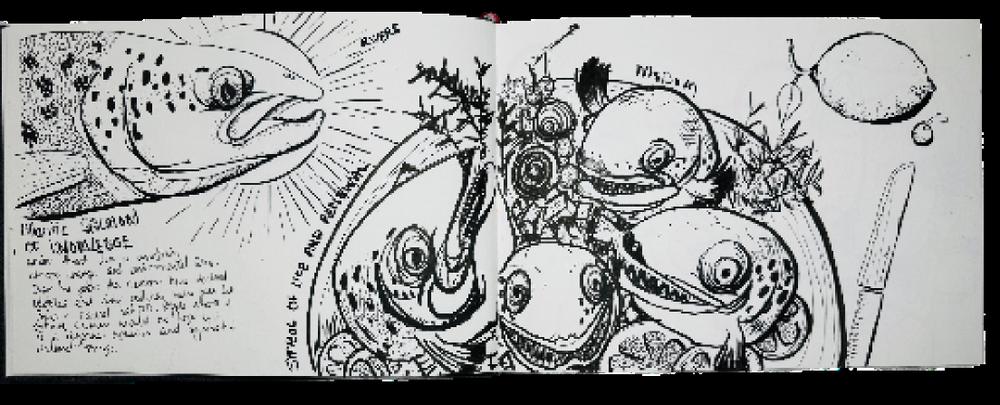
Research for this body of work began with foundational sketching as a way of figuring out what I most needed to say. Using a long landscape-format sketchbook and rapid brush-pen drawings, I started exploring the subjects that felt most urgent to me, which became protest against injustice, especially around climate change, industrial farming, habitat loss, and the impact of human systems on the natural world. That sketchbook became a profoundly important part of the process, not just for generating ideas but for clarifying meaning.
From there, research continued through trial, testing, reading, critique, and direct experience. I discovered materials and methods that became central to the work, especially sanguine and charcoal, whose classical quality felt like a powerful counterpoint to contemporary subject matter. Alongside that, I experimented with text, surfaces, pigments, pastel ground, wood, and methods of fixing and sealing, with some routes becoming integral and others remaining promising but unresolved.
Trial through sketching
Early explorations, studies, and the generative thinking that seeded each body of work.
Extinction and Genocide
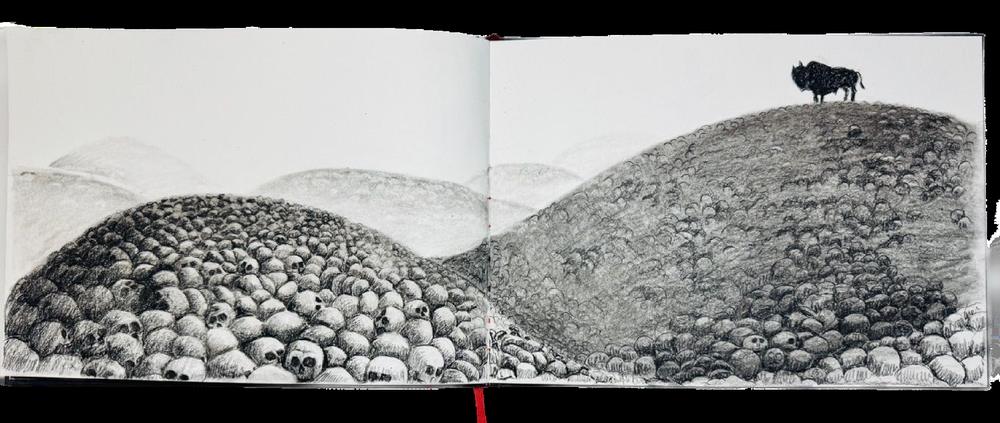
Sketchbook study for The Last Stand. A lone bison stands on a mountain of human skulls. The American bison slaughter was never just about animals. It was a deliberate strategy to destroy the food source, economy, and way of life of Indigenous peoples. The skulls in this drawing are human because the genocide was human as well as animal. Over 60 million bison were killed by 1889, and the Native American populations who depended on them were starved, displaced, and killed alongside them. I drew the skulls individually, letting them dissolve into haze in the distance, to make the scale of that destruction something you have to sit with rather than skip past as a number. This study became the direct blueprint for the resolved sanguine piece.
Rhino horns
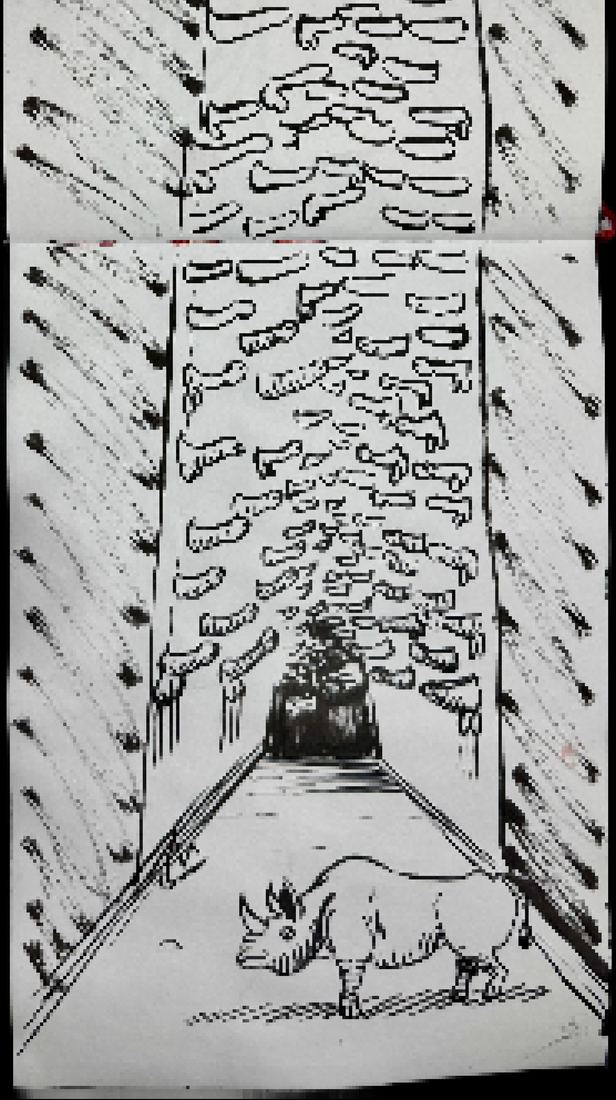
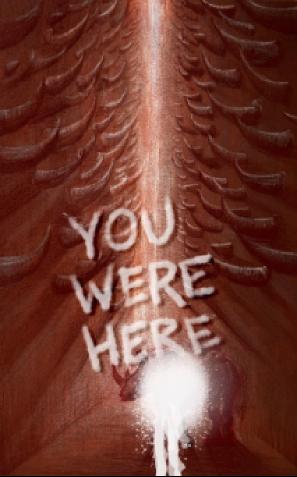
Early compositional studies for what became The Last Passage. I was working out how to use the severed penises as an architectural element, creating a narrowing corridor that the rhino must walk through. The idea of passage, both physical and metaphorical, emerged here.
The dairy industry
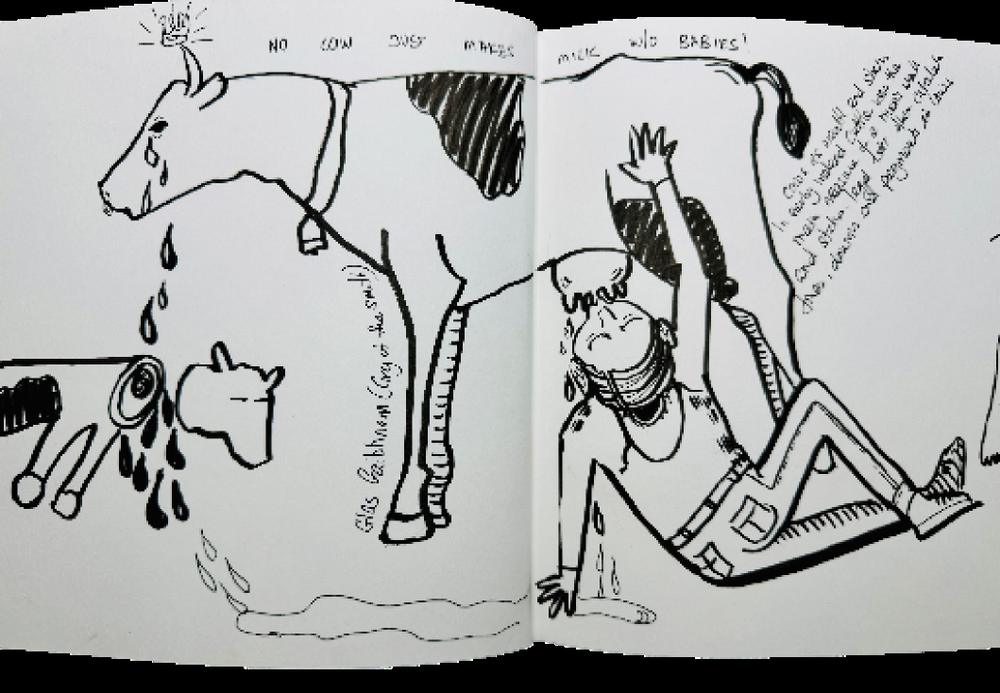
Research drawings looking at the hidden costs of industrial dairy farming. I explored imagery of irony, extraction, and the mechanical processing of living bodies. The sketches were rough and exploratory, but they pushed me to think about how protest could be embedded in observation.
Slaughterhouses
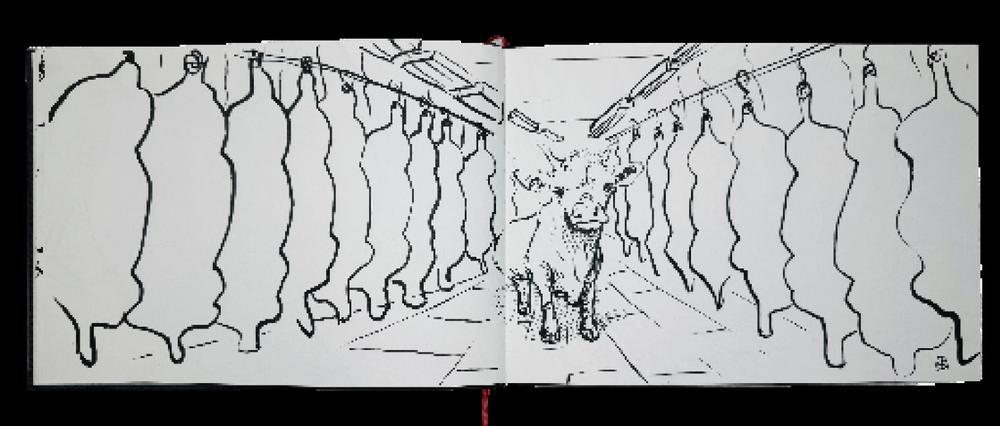
Early sketch exploring the industrial scale of animal slaughter. I was drawn to the visual contrast between the sterile efficiency of the production line and the violence it conceals. If slaughterhouses had glass walls we’d all be vegan.
The fur business
Exploratory drawing about the global fur trade. I researched the scale of fur farming and the disconnect between the glamour of the product and the reality of its production.
Hunting
Early sketchbook studies on hunting and the commodification of living beings. The hare sits surrounded by flora but the handwritten notes around it map out the ecosystem it depends on and how quickly that system unravels when species are removed for sport or trade. The fox drawings push further into that tension between tenderness and violence. These pages were where I started thinking about animals not as symbols but as individuals caught inside structures they cannot see.
Squid as Magical Beings Not Food
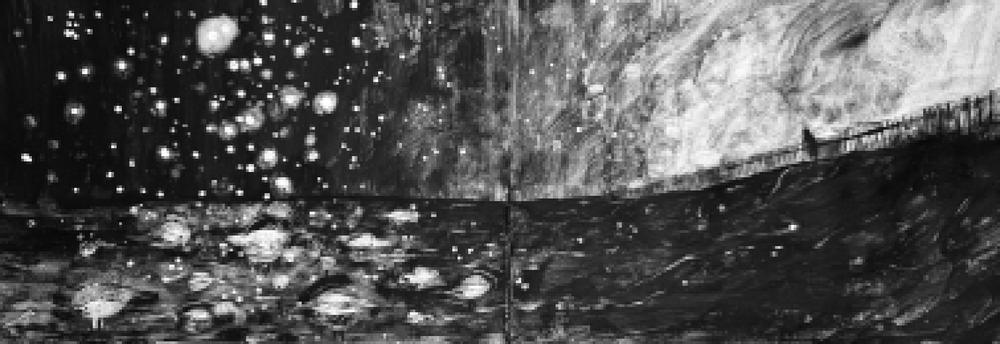
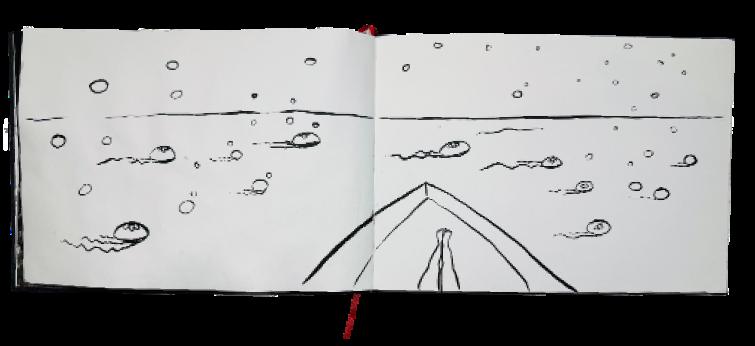
Research sketches exploring deep-sea bioluminescence and the vulnerability of marine ecosystems. The phosphorescent squid fascinated me as a subject because it is both alien and fragile, a creature most people will never see, quietly disappearing. These studies pushed my drawing toward more atmospheric, light-based compositions.
Whaling
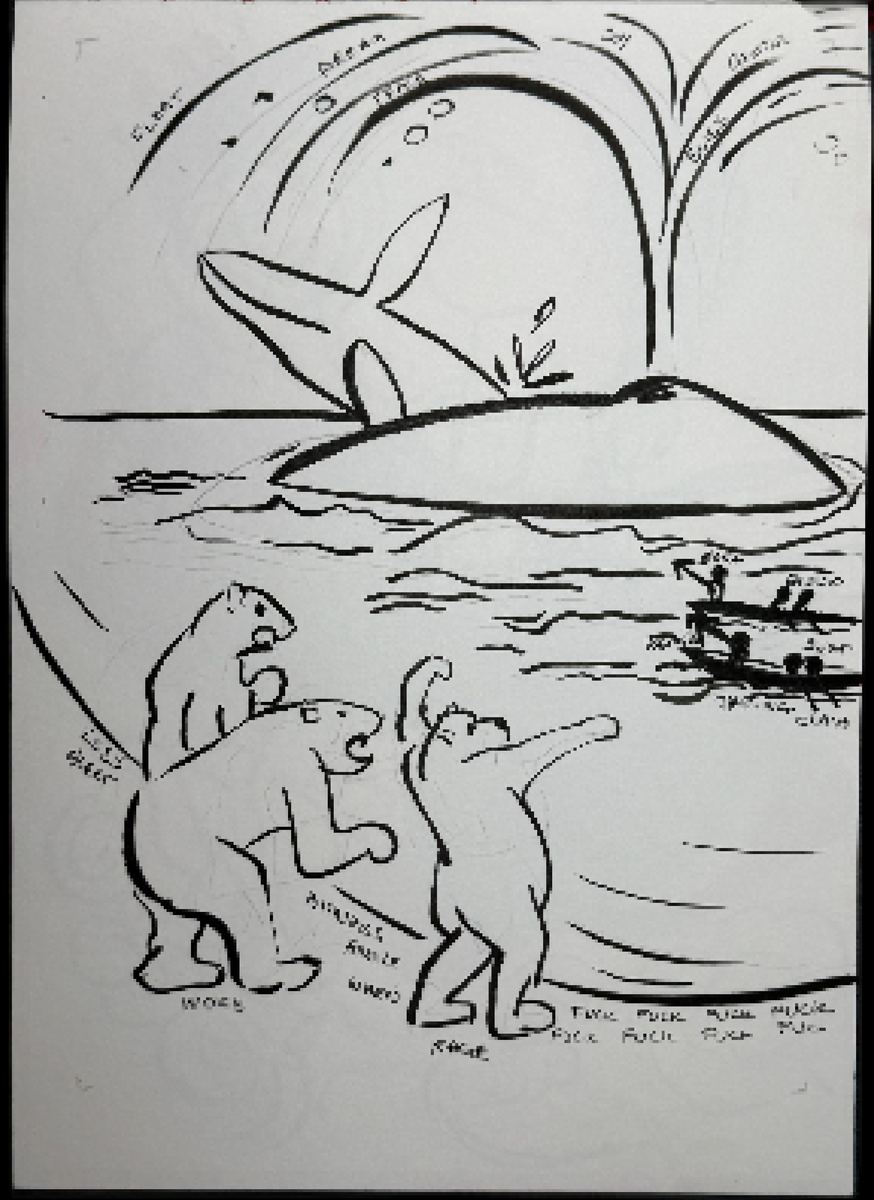
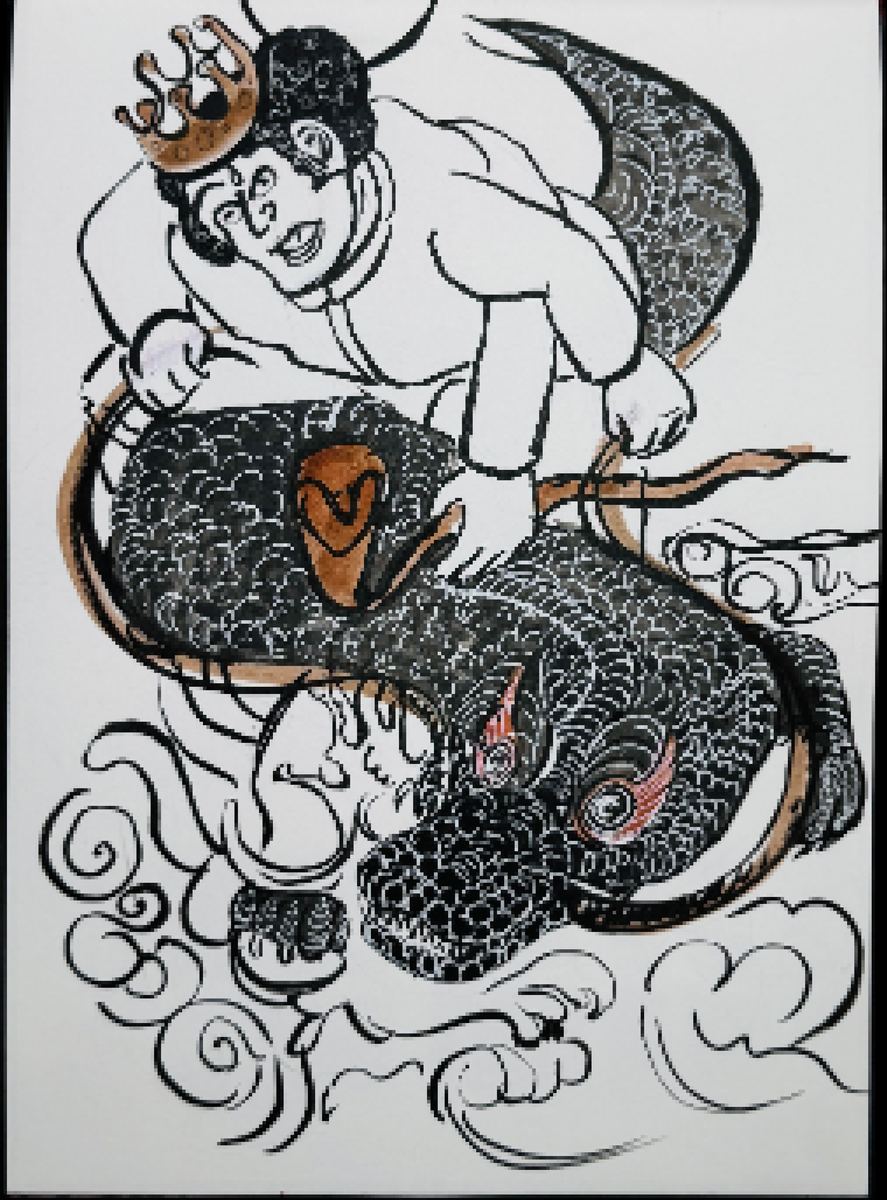
Studies on the history and ongoing reality of commercial whaling. I was looking at the sheer physical scale of whales and how that scale could be used in composition to overwhelm the human figure. These drawings were testing grounds for the relationship between the monumental animal body and the small, complicit human.
Trawling
Exploratory work on industrial trawling and bycatch. The nets, the volume of unintended catch, the indiscriminate destruction of ocean ecosystems. I was trying to find a visual equivalent for the scale of waste, something that could make the viewer understand the numbers physically rather than abstractly.
Gods of the earth
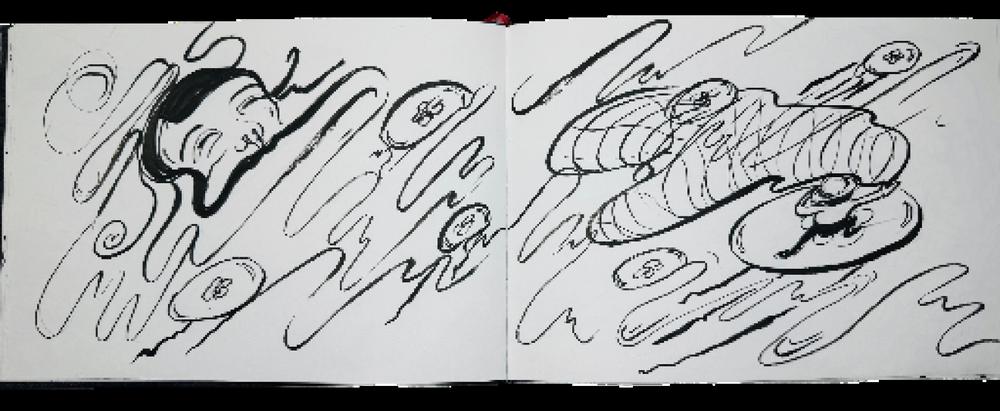
These sketches explored how dominant religious frameworks position humanity as separate from and superior to the natural world. The idea of dominion, granted by divine authority, has underpinned centuries of ecological destruction. I wanted to imagine an alternative cosmology where the earth itself is sacred, not a resource to be managed. This thread runs through the entire body of work: the animals in my drawings are not symbols. They are protagonists.
Rising Sea Levels
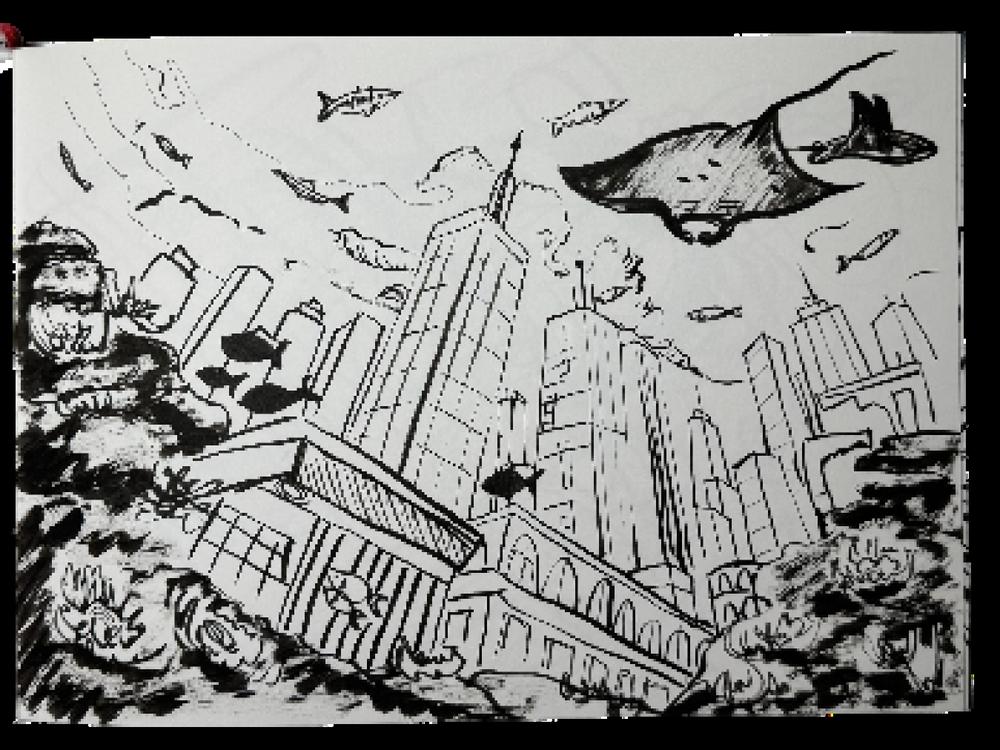
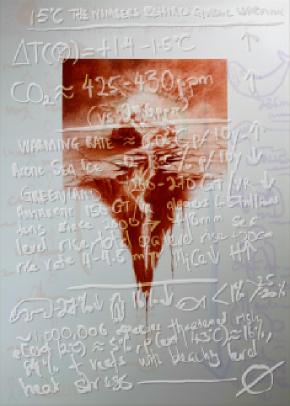
Early studies on rising temperatures, ice loss, and the visual language of climate breakdown. I was experimenting with how to show something disappearing.
Logging
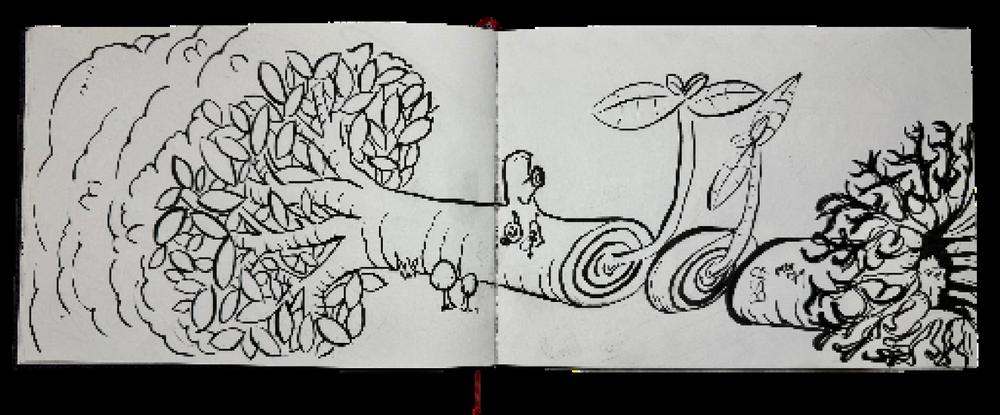
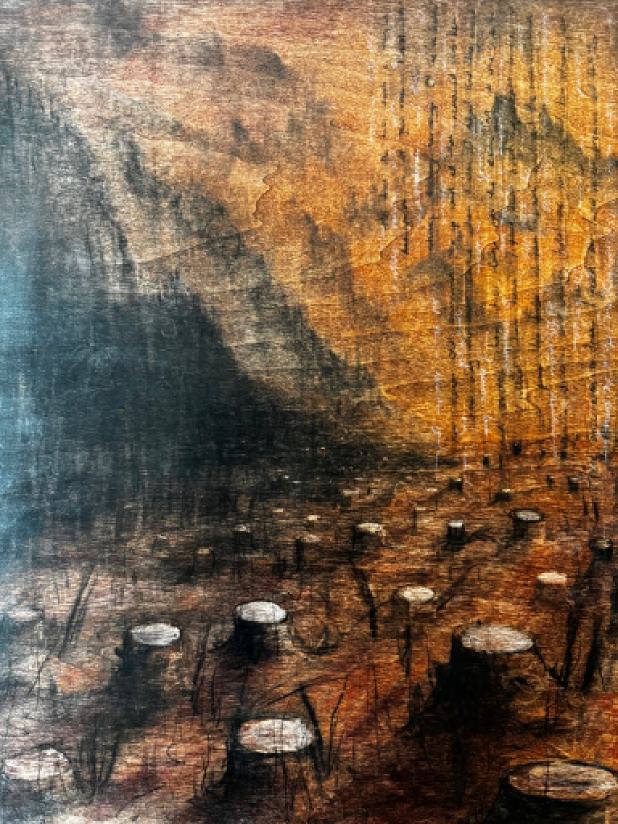
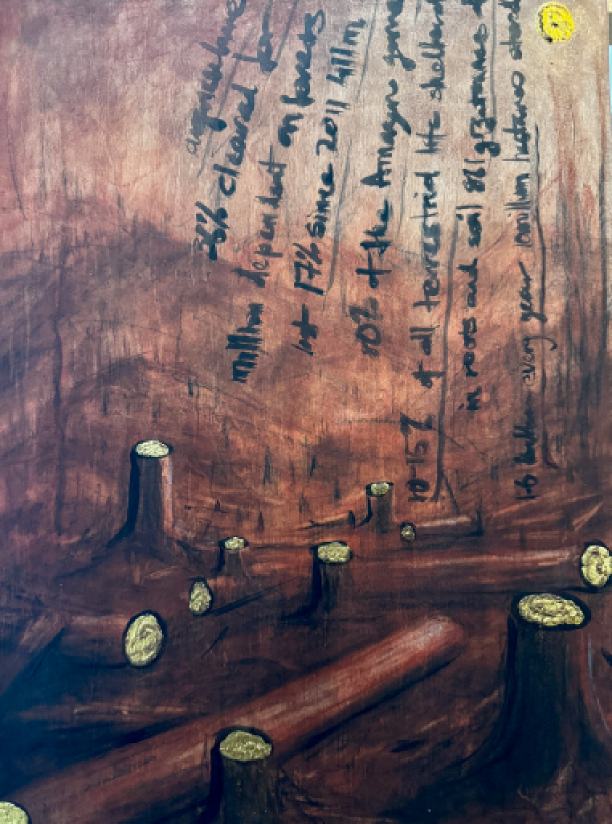
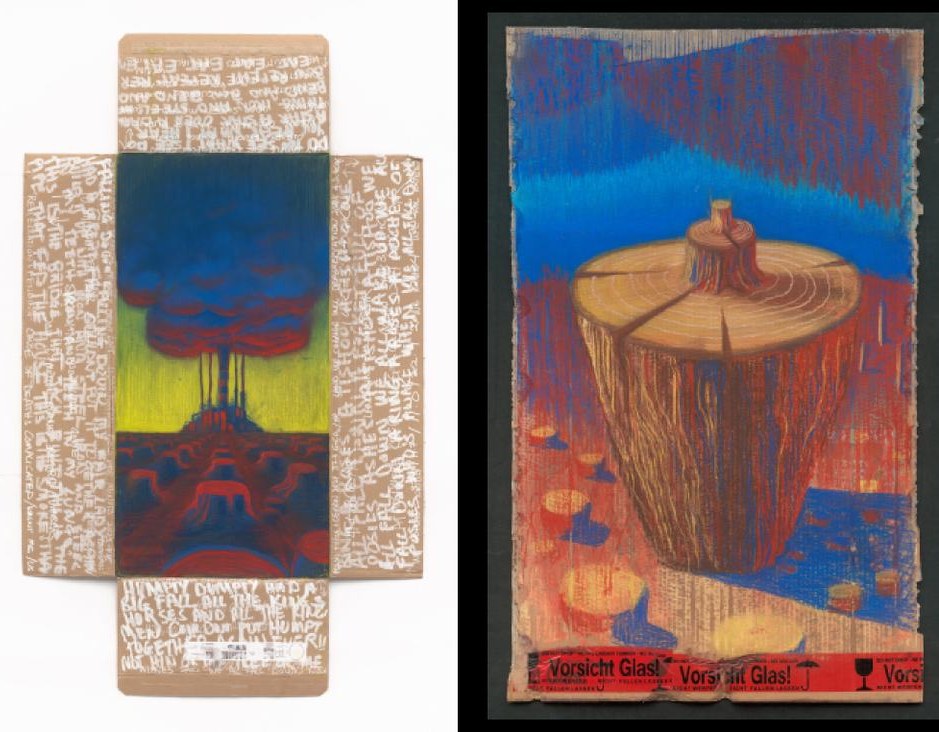
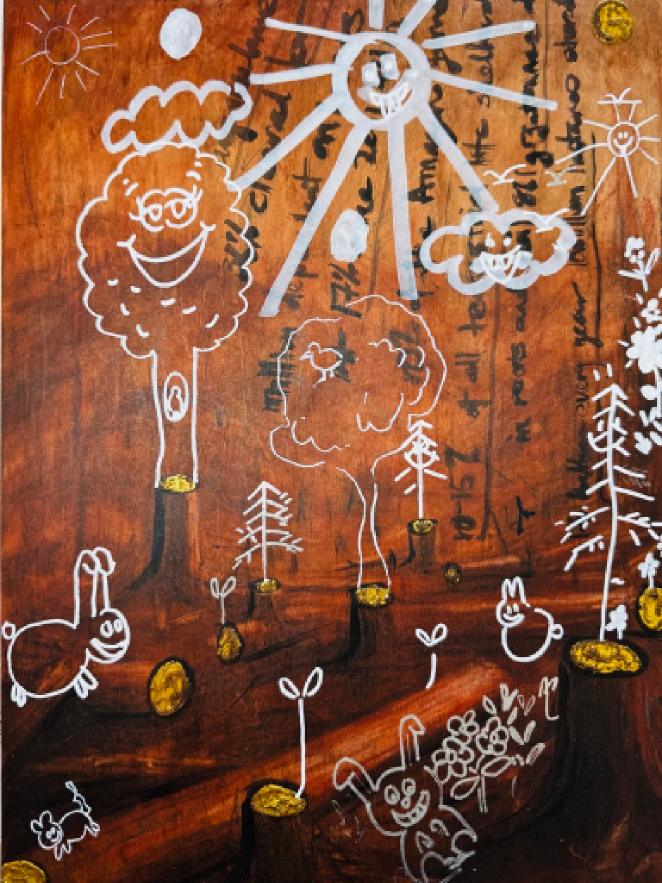
Research drawings on deforestation and industrial logging. I was collecting statistics, satellite imagery, and photographs of clear-cut landscapes, and translating that material into mark-making. The found cardboard pieces grew directly out of this research: painting on the remains of a tree felt like the most honest surface for the subject.
Salmon extinction
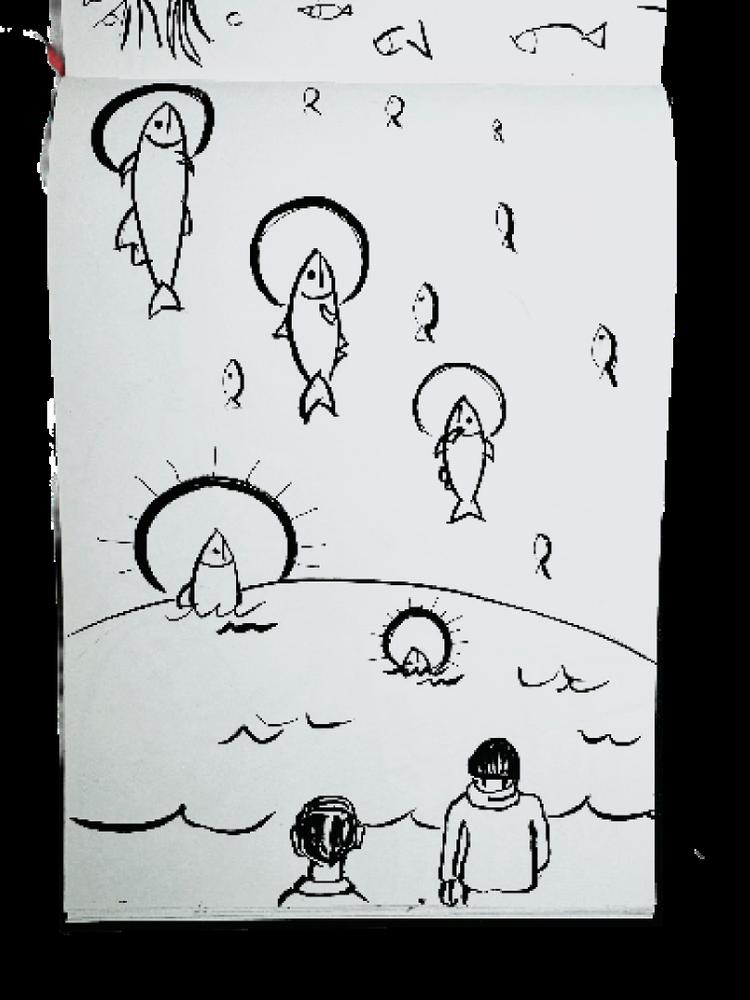
Initial studies on the collapse of wild salmon populations. I was interested in the paradox of abundance turning to absence, and I began experimenting with suspended forms and empty space to suggest what is no longer there. These sketches fed directly into The Last Run.
Climate change
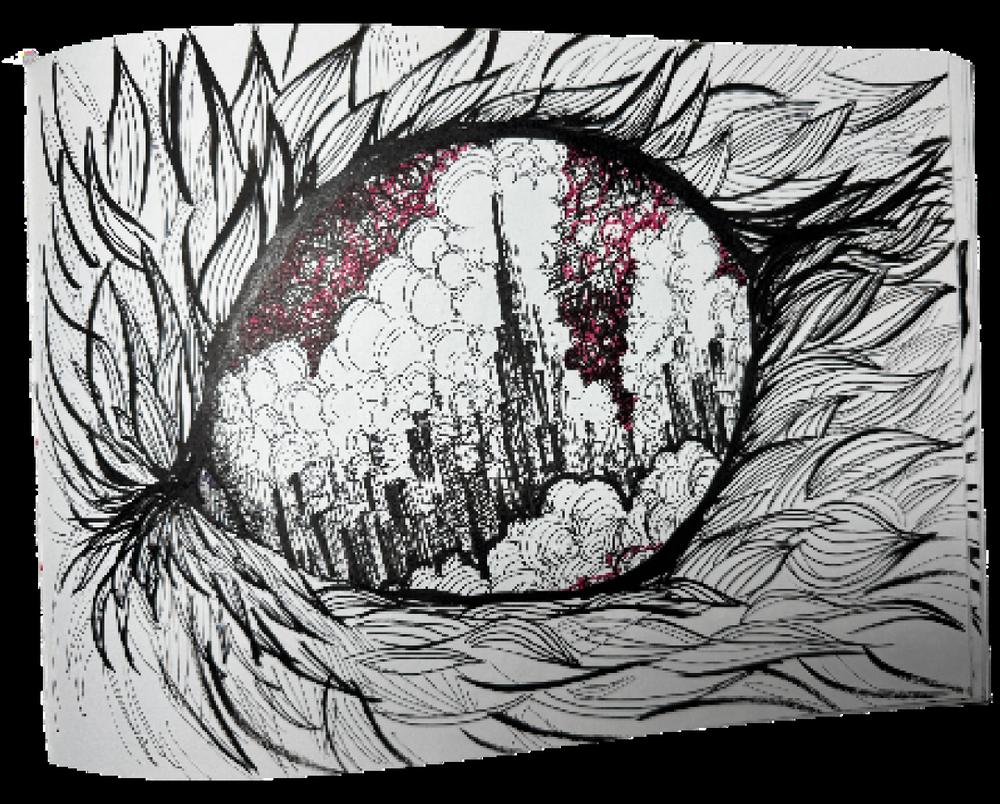
An industrial skyline choking on its own smoke, seen through the eye of an animal. The idea was that the animal sees everything we do and has no say in it. Wars, factories, emissions, all of it reflected back at us through a creature that bears the consequences but never caused them. This sketch was an early test of using the animal's body as a framing device for human destruction.
Global Warming
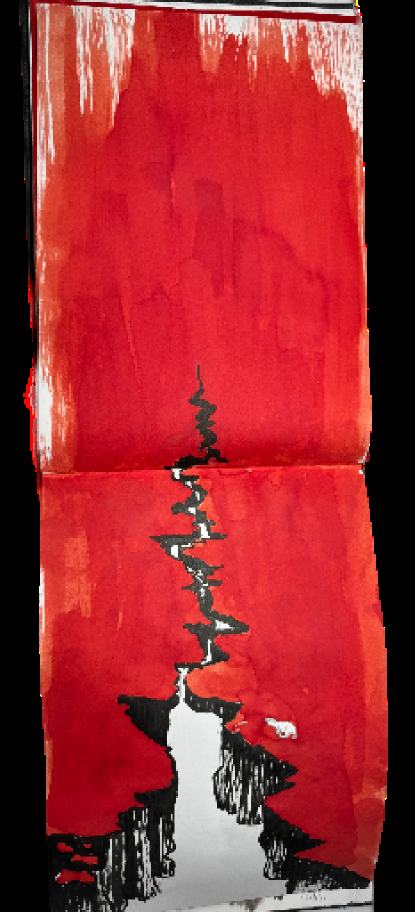
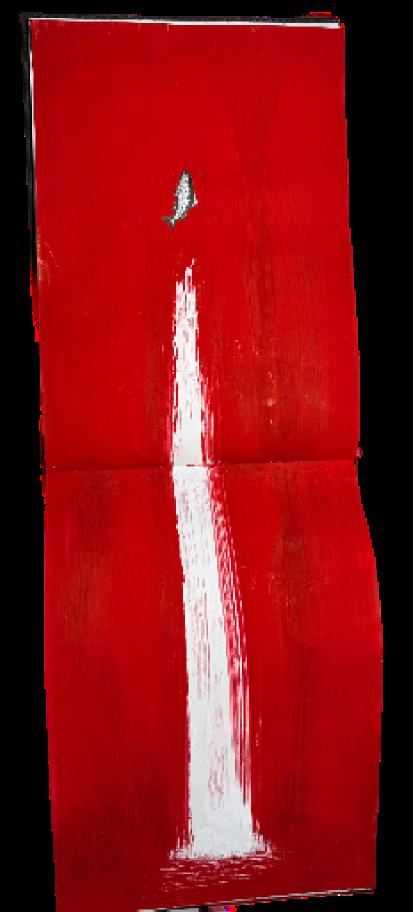
These are early studies on global warming that fed directly into The Last Ice. The left piece tests the idea of a landscape splitting apart, a jagged black fissure cracking through saturated red. The right places a single fish above a white void, a river or reef system that has bleached out or dried up. Together they were me working out how to show environmental collapse through colour and absence rather than detailed figuration. The red became scorched earth. The white became what is no longer there. That shift from depicting a thing to depicting its disappearance is what eventually became The Last Ice, where the iceberg dissolves beyond the edges of the paper and refuses to stay contained.
Testing through experimentation
Materials, surfaces, and directions — some resolved, some parked, all instructive.
Sanguine and Charcoal
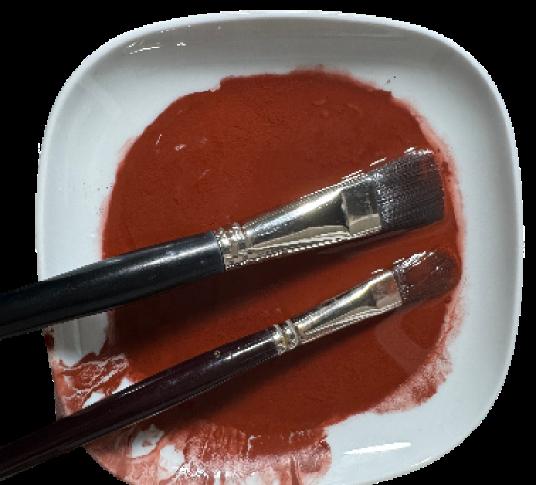
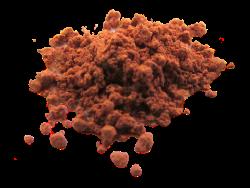
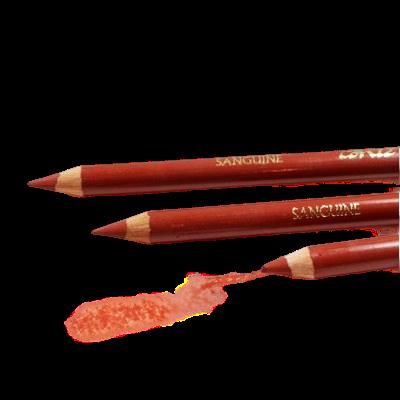
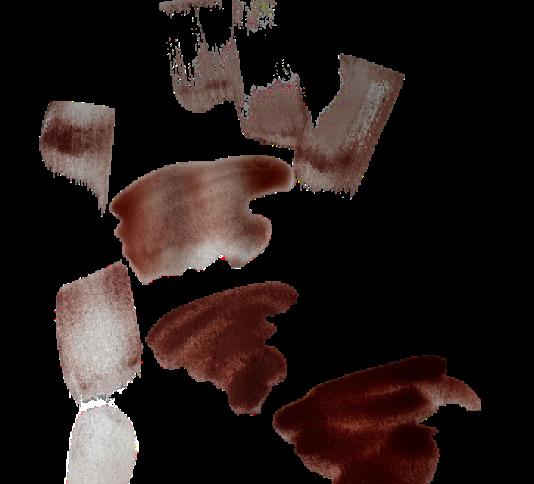
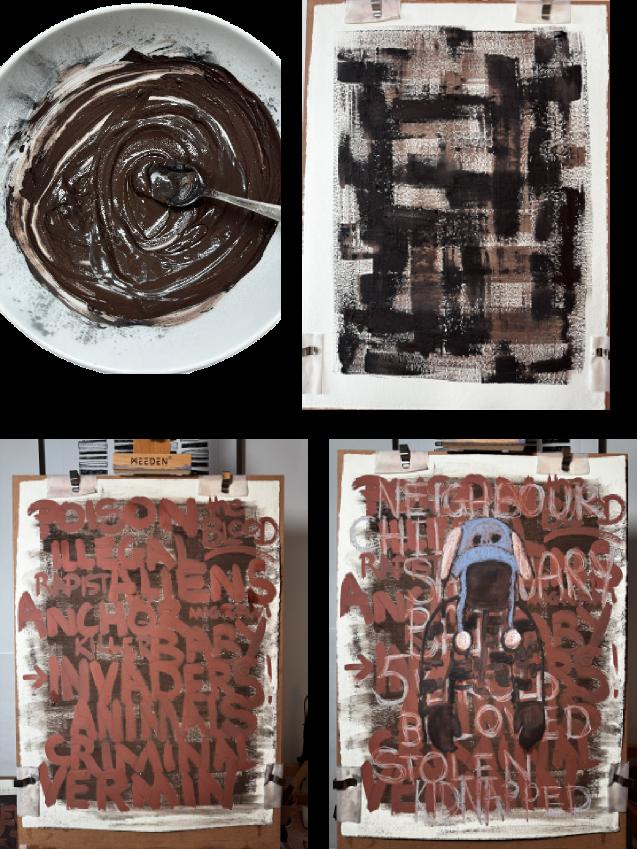
I knew I loved the colour of sanguine from the start, and I’m drawn to chalk as well. There is something about both materials that feels soft and delicate, yet still vivid and alive. I experimented with different ways of using them, including pencil, powder, sticks, pastel sticks, and pastels. One process I especially began to enjoy was wetting the powder and turning it into a kind of mud that I could paint directly onto the surface. I liked working into it while it was still wet, and then returning to it once dry, using the eraser to lift out light and shape, then adding and removing again through layered marks. It was a messy process, but a very exciting one, and it led to some really strong results. I can definitely see myself continuing with sanguine. It feels classical and dramatic at the same time, and I like the way it acts as a counterpoint to the more surreal, modern subjects I’ve been working with.
Text
I began experimenting with ways to combine text elements (as I did in my sketches) with the more finished sanguine drawings. I created a series of digital mock-ups in Procreate and Photoshop to test how text might sit within the image. Those early attempts did not feel visually successful, so I paused that direction for the moment. However, the idea did carry through into the Logging piece, where the text appears in a much more subliminal way. I have continued to explore different approaches, although I have not yet found a resolution that feels fully convincing. Even so, I still believe the idea has potential and is worth pursuing further.
Further Experiments with Text and Surface
In these works, I continued trying to bring the energy of the text-based elements from my sketches into my quieter, more resolved drawings. In one, the marks became more scrawled and light-like, almost radiating across the image. In the other, the text shifted into something more subliminal: illegible, but suggestive of calligraphy within Chinese landscape painting. Neither approach has fully landed for me yet, but the experiments were still valuable. They pushed me to keep testing how text, mark-making, and atmosphere might coexist without overwhelming the image. I also continued experimenting materially, using gold leaf and cold wax to seal powdered pigment onto wood. Through this process, I learned that the surface should not be primed first if I want that method to work well. On unprimed wood, the results were much more striking.
Further Experiments with Text and Abstraction
This piece developed out of the previous text experiments, but here I became especially drawn to working directly with dry pigment on wood. In this case, I applied it onto a clean birch panel without staining the surface first, which gave the piece a rawness and immediacy that I really liked. I also began to bridge the gap between the scrawled text elements and the more finished drawings by moving toward a more abstracted version of the landscape. This feels important to me, as it begins to resolve a point raised in my first crit, when Colin suggested that the work might be stronger without the central protagonists. The logging pieces already move in that direction, but abstraction seems to push them further into a more conceptual space. I feel much closer here to something that could work. What I like is the surface, the materiality, and the more abstract treatment of the image. What still feels unresolved is the style of the script, which I do not think has fully landed yet.
Experimenting with Surface and Found Materials
I began thinking more deliberately about the surface itself. I discovered pastel ground and realised that it could be painted onto almost any support, creating a surface that would hold dry pigment beautifully. It also felt important conceptually. I had become increasingly aware of the contradiction of using new materials to support work concerned with environmental damage, so I began looking for found surfaces instead. I salvaged large pieces of discarded cardboard from the rubbish room downstairs, coated them with pastel ground, and found that they took the pigment extremely well. I also kept incidental details such as the edges of the box and the “fragile” sticker, which felt entirely right within the work. In the second piece, I was interested in retaining something of the box’s original three-dimensional form while continuing my ongoing experiments with text. I dismantled the box and cut away sections until it formed a cruciform shape, which I found very compelling. Although I think these works contain real potential, I also feel they are not yet resolved. For now, I have set this direction aside, but I think it offers strong possibilities for further development later.
A More Confrontational Experiment
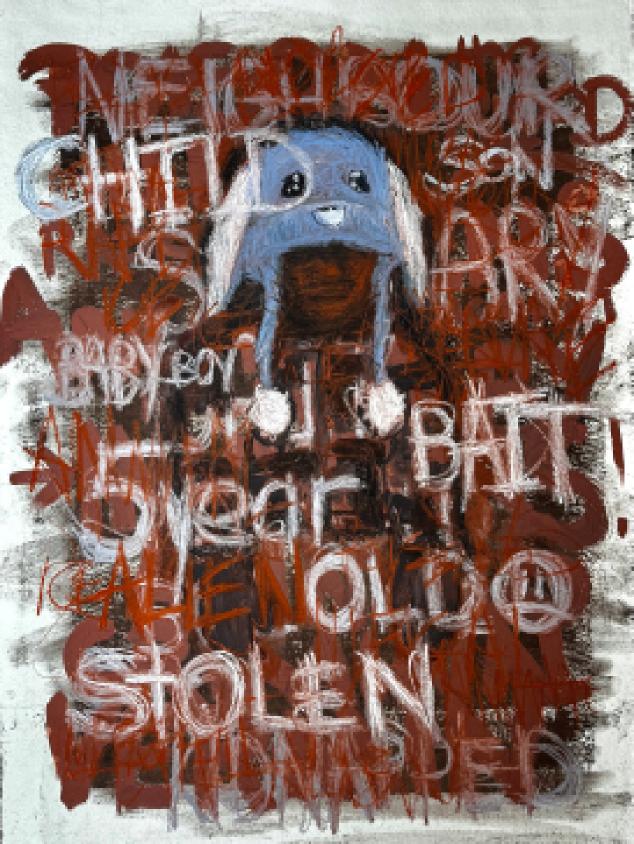
In this piece, I moved away from the quieter, more seductive quality of the earlier works. Although I kept using sanguine, charcoal, and text, the energy became much more raw, instinctive, and confrontational. Working quickly on cotton rag, I layered wet and dry pigment with emotionally charged text, building an image shaped by rage, conflict, and contradiction. I like its force and complexity, but it still feels unresolved. I suspect the chalk-based medium may not be right for it, and that paint or something more vivid and permanent might serve it better. For now, I have parked it as another important experiment in style, theme, and medium.
From Drawing to Protest Sign
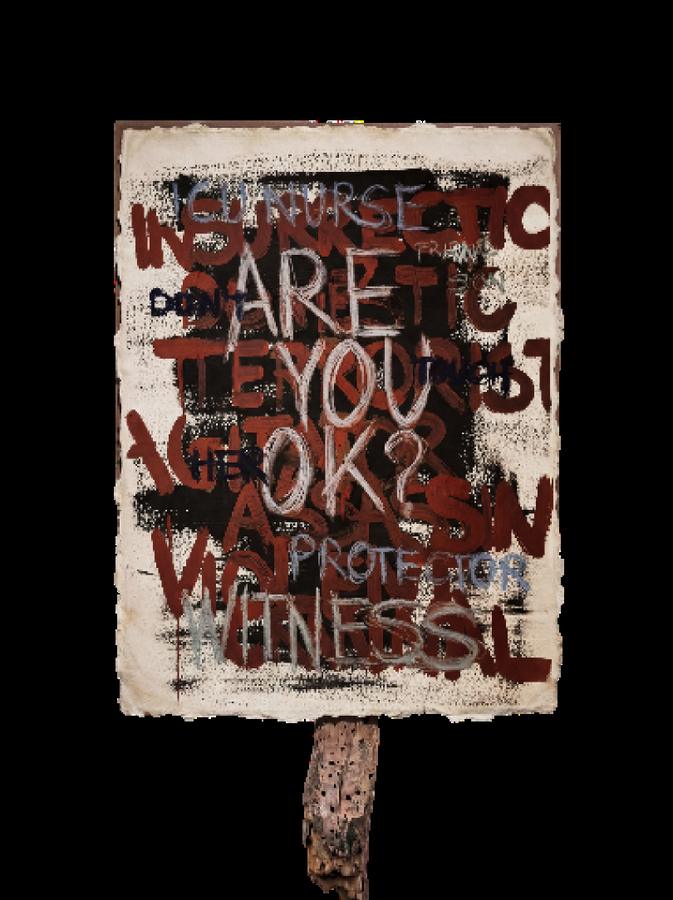
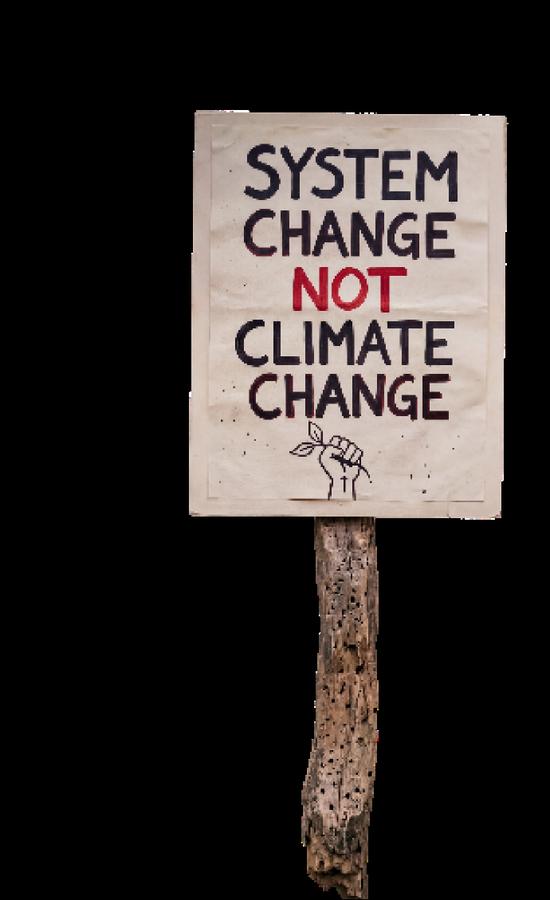
This experiment grew out of Colin’s suggestion that these works might function as actual protest signs. I had rough wooden boards made and mocked the pieces up in that format, which immediately gave them a stronger physical presence. I especially liked the rawness of the supports and the way they connected the work more directly to activism and public address. At the same time, the drawings themselves still do not feel fully resolved. I think the idea is extremely promising, but the image on the sign may need to be more resolved, perhaps closer in finish to my more developed pieces. For now, I see this as a very strong direction with real potential, and one I want to return to later.
Injecting Playfulness into the Dark
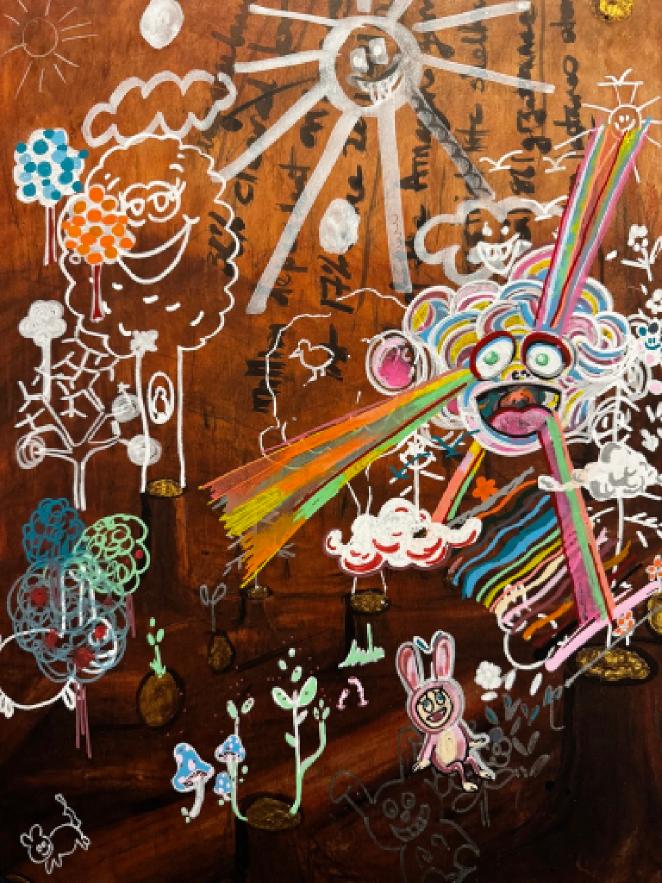
In this experiment, I was testing several things at once. I wanted to see what would happen if I overlaid my darker, more atmospheric sanguine imagery with a more playful anime or cartoon-like visual language. I was also testing whether acrylic would work over the cold wax surface, and it does. Although these particular results feel excessive and unresolved, some of the visual ideas feel promising. Small elements, such as the teal shoots emerging from the logs, seem as though they could lead somewhere interesting. Even though these examples are messy and not successful as finished works, this is actually one of the directions I feel most excited by. I can see the potential in it, and I want to keep pushing it further.